Choosing between invasive and noninvasive ventilation can shape a patient’s comfort, risks, and level of monitoring. The question “what is the difference between invasive and non invasive ventilation” is not just about equipment. It concerns how breathing support reaches the lungs, when each method may be appropriate, and how clinicians respond if a patient worsens. A mask can look simple beside a ventilator circuit, but safe use depends on careful assessment.
Respiratory-care expert Dean Hess’s work offers a useful principle, paraphrased here: “The key distinction is whether support requires an artificial airway.” Noninvasive ventilation usually delivers pressure through a snug face mask or helmet. Invasive ventilation uses an endotracheal tube or tracheostomy connected to a ventilator. That difference affects comfort, communication, airway protection, and possible complications. It also changes what staff must watch, from mask leaks and skin pressure to tube position and sedation needs.
The five differences in this guide are the interface, typical use, patient experience, risks, and monitoring or escalation. The boundary is not always neat. Some patients begin with mask support, then need an airway if breathing or alertness declines. Others may be unsuitable for a mask from the outset. Context matters. A ventilator choice should be made by qualified clinicians, based on the person’s condition and response—not on a device label alone. Even a clear comparison has limits; real patients rarely fit a tidy table.
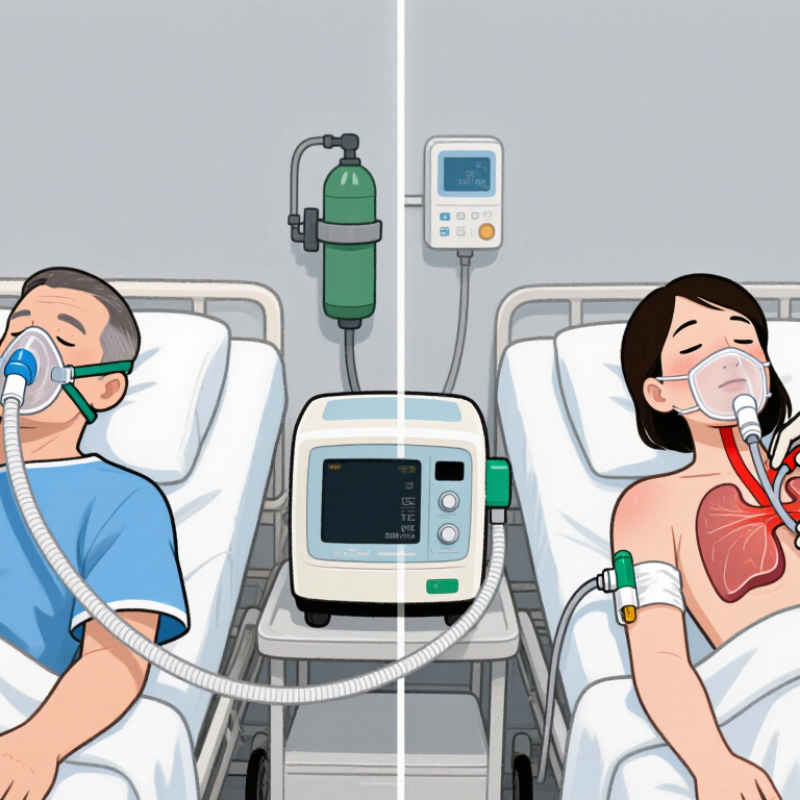
Invasive ventilation and noninvasive ventilation both help move air, but they deliver support differently. Invasive ventilation sends air through a tube placed in the windpipe, or through a tracheostomy. It can provide steady support when a person cannot breathe adequately or protect their airway. Clinicians adjust pressure and oxygen while monitoring breathing, blood gases, and comfort. The tube may irritate the throat, and sedation is sometimes needed. It also carries risks, including infection and airway injury.
Noninvasive ventilation delivers pressure through a snug mask over the nose or face. Common forms include CPAP and BiPAP, which can help keep airways open or ease the work of breathing. The person usually remains awake and breathes without a tube in the windpipe. The fit matters. A loose seal can leak air; a tight one can leave red marks on the nose. Some people feel claustrophobic or develop dry eyes. Mask ventilation may not be safe when someone cannot protect their airway or manage secretions. The choice depends on the cause of breathing difficulty, alertness, and response to treatment. Even a well-fitted mask can feel frustrating, and that discomfort deserves attention—not dismissal.
In invasive ventilation, air reaches the lungs through a tube placed inside the airway. An endotracheal tube usually passes through the mouth, beyond the vocal cords, and into the trachea. For longer-term support, a tracheostomy tube enters through an opening in the neck. These interfaces provide a more controlled route for delivering breaths, but they require trained insertion and ongoing airway care.
Noninvasive ventilation delivers pressure through an external interface. Common options include a nasal mask, an oronasal mask covering the nose and mouth, or nasal pillows that rest at the nostrils. The best fit depends on breathing pattern, facial shape, comfort, and the support needed. Small details matter. A mask can look secure and still leak when a patient turns. Pressure on the nose can also cause soreness, so fit and skin checks are important.
The distinction is not simply tube versus mask. Invasive tubes bypass the upper airway; masks do not, and they may leak or be harder to tolerate. Yet a tight mask is not automatically better. Clinicians assess breathing, alertness, secretions, and the person’s ability to cooperate when choosing an interface. No interface fits every face or situation perfectly, and that is worth reassessing during treatment.
Clinicians choose ventilation by weighing urgency, airway safety, and whether the patient can tolerate a mask. Noninvasive ventilation (NIV) delivers support through a fitted face or nasal mask. It may suit an alert patient who can protect their airway and manage secretions, especially during a COPD flare with respiratory acidosis. Fit matters. A leaking mask, panic, or heavy secretions can quickly undermine treatment.
The 2017 ERS/ATS clinical practice guideline reports pooled COPD trial results: NIV was associated with lower mortality (risk ratio 0.63) and fewer intubations (risk ratio 0.41) than usual care. These figures describe study groups, not a promise for any one patient. Clinicians monitor breathing effort, oxygen levels, blood gases, comfort, and mental status. If these worsen, continuing NIV may delay needed airway support.
Invasive ventilation uses a tube placed into the trachea and a ventilator to control breathing more directly. Clinicians may choose it when a patient cannot protect their airway, has severe exhaustion, or remains unstable despite NIV. It also brings risks, including pneumonia and airway injury, so it is not automatically the “stronger” choice. Reassessment is essential. Bedside decisions can be messy; a single blood-gas value rarely tells the whole story.
| Difference | Invasive Ventilation | Noninvasive Ventilation | When Clinicians May Choose It |
|---|---|---|---|
| Airway interface | Delivers ventilatory support through an endotracheal tube or tracheostomy tube placed in the airway. | Delivers support through an external interface, such as a face mask, nasal mask, or helmet; it does not bypass the upper airway. | Invasive ventilation is considered when a secure airway is needed. Noninvasive ventilation may be tried when the patient can breathe spontaneously and tolerate the interface. |
| Airway protection and secretions | The airway tube can facilitate suctioning and ventilation, but it does not eliminate aspiration risk. | Does not secure the airway; heavy secretions, vomiting, or difficulty protecting the airway can make it unsuitable. | Clinicians may favor an invasive airway when airway protection or secretion management is inadequate. Suitability depends on the patient's condition and risks. |
| Common clinical situations | Used for severe respiratory failure, apnea, or when noninvasive support is unsuitable or has failed. | Frequently used for selected cases of acute COPD exacerbation with respiratory acidosis and acute cardiogenic pulmonary edema; it may also be appropriate in other selected conditions. | The choice depends on the cause and severity of respiratory failure, the patient's clinical status, and the likelihood of response. |
| Patient participation and comfort | Does not require the patient to tolerate a face mask, but an artificial airway can be uncomfortable; sedation may be needed, and clinicians generally aim to use it judiciously. | Usually requires spontaneous breathing, mask tolerance, and enough cooperation to manage the interface. Leaks or claustrophobia can limit use. | Noninvasive support may suit an alert, cooperative patient. Inability to tolerate the interface or worsening distress may prompt a change in strategy. |
| Risks and reassessment | Risks include airway injury, ventilator-associated pneumonia, and complications related to sedation or prolonged ventilation. | Risks include mask pressure injury, air leaks, gastric insufflation, and aspiration; delayed intubation is a concern if treatment is failing. | Both approaches require close monitoring. Clinicians reassess breathing, oxygenation, ventilation, and overall stability, escalating support promptly when needed. |
Clinical note: Ventilation decisions are individualized and depend on the patient's diagnosis, examination, response to treatment, and goals of care. This comparison is educational and does not replace clinician judgment.
Noninvasive ventilation (NIV) delivers breathing support through a fitted mask, avoiding a tube in the windpipe. For suitable patients, it can help preserve speech and reduce sedation needs. An ERS/ATS clinical practice guideline recommends NIV for many people with COPD flare-ups and respiratory acidosis. A Cochrane review of acute COPD exacerbations found NIV reduced the relative risk of death by 46% and intubation by 64% (Cochrane Database of Systematic Reviews, 2017; CD004104). These results apply to studied patients, not every cause of breathing failure.
NIV’s limits matter. A leaking mask can dry eyes, irritate skin, or make eating and speaking difficult. It may fail when a patient cannot protect their airway, clear secretions, or tolerate the mask. Invasive ventilation uses a tube and can provide dependable airway access and controlled breathing. It also brings risks, including infection, airway injury, and complications from sedation. It is not automatically the stronger choice. The right approach depends on the cause, severity, and response to treatment, with close clinical monitoring.
Tips: Watch the person, not just the monitor. New confusion, worsening breathlessness, or falling oxygen levels need urgent clinical assessment. NIV should be reassessed early; delaying a needed change in support can be harmful. A mask trial can feel reassuring, but it is not always successful.
Ventilation supports breathing when the body cannot move enough air or oxygen. Noninvasive ventilation delivers pressure through a fitted mask, while invasive ventilation uses a tube placed in the windpipe. Mask support avoids a breathing tube, but can cause facial pressure, dry mouth, or air leaks. Invasive support may be needed when breathing is severely impaired or a person cannot protect their airway. It carries risks such as airway injury, infection, and complications from sedation.
Close monitoring matters. Clinicians assess oxygen levels, breathing effort, alertness, and sometimes blood gas results. They also check for mask sores, secretions, discomfort, or signs that breathing is worsening. Transitioning between methods depends on the person’s condition, not a fixed timetable. A team may reduce support, assess breathing, and watch closely before changing devices. Progress can be uneven; one difficult trial does not always settle what comes next.
Tips: Tell the care team if the mask feels too tight, breathing becomes harder, or confusion develops. During a transition, follow the team’s instructions and report new symptoms promptly. Do not adjust prescribed settings yourself.
A tube enters the windpipe, or air passes through a tracheostomy. A ventilator delivers air and oxygen while clinicians adjust pressure. Monitoring continues.
A snug mask over the nose or face delivers pressure. The person usually stays awake and breathes without a windpipe tube. Fit matters.
It may help an alert person who can protect their airway and manage secretions. It may be considered during a COPD flare with respiratory acidosis.
Clinicians may consider one if someone cannot protect their airway, is severely exhausted, or remains unstable despite mask support. Real bedside decisions can be messy.
A loose seal may leak air. A tight mask can leave red marks on the nose. Dry eyes or claustrophobia can also happen. Discomfort matters.
A tube can irritate the throat. Sedation may be needed, and risks include infection, pneumonia, or airway injury. It is not automatically the better choice.
A 2017 guideline reported lower mortality and fewer intubations in pooled COPD trials than with usual care. The risk ratios were 0.63 and 0.41. These are group results, not guarantees.
They reassess breathing effort, oxygen levels, blood gases, comfort, and mental status. If these worsen, continuing mask support may delay needed airway support. One blood-gas value rarely tells the full story.
This article explains how invasive and noninvasive ventilation support breathing, comparing the airway interfaces and the situations in which clinicians may choose each method. Invasive ventilation delivers breathing support through a tube placed in the airway, while noninvasive ventilation provides assistance through an external interface, such as a mask. Understanding what is the difference between invasive and non invasive ventilation can help readers see how the approaches vary in access to the airway, patient comfort, and the level of support provided.
Both methods can offer important benefits, but each has limitations and potential risks. The article considers factors clinicians assess when selecting an approach, including a patient’s breathing needs and ability to use the interface. It also highlights the importance of close monitoring and explains that care teams may adjust support or transition between methods as a patient’s condition changes.

QMS Medical