How long can a patient stay on a ventilator? The honest answer depends on the illness, lung function, neurological status, and response to treatment. Some patients need ventilatory support for only a few hours after surgery. Others remain dependent for days, weeks, or longer. There is no universal deadline.
Professor Luciano Gattinoni, a leading researcher in critical care and mechanical ventilation, has warned, “Mechanical ventilation is not a benign intervention.” His observation matters because a ventilator can support breathing while the body heals, yet prolonged use may increase risks. These include ventilator-associated pneumonia, airway injury, muscle weakness, and difficult weaning. The machine helps, but it does not cure every underlying problem.
Doctors usually assess progress through oxygen needs, blood-gas results, breathing strength, alertness, and the cause of respiratory failure. Daily trials may test whether the patient can breathe with less assistance. Sometimes progress is uneven. A patient may improve, then need more support after infection, surgery, or exhaustion.
That uncertainty can feel frightening for families. It also makes simple timelines misleading. If ventilation continues for an extended period, clinicians may discuss a tracheostomy, but timing varies widely. The decision should reflect medical evidence, the patient’s wishes, and realistic recovery goals. This article explains the factors that influence how long can a patient stay on a ventilator, what prolonged ventilation can involve, and which questions families should ask the care team.
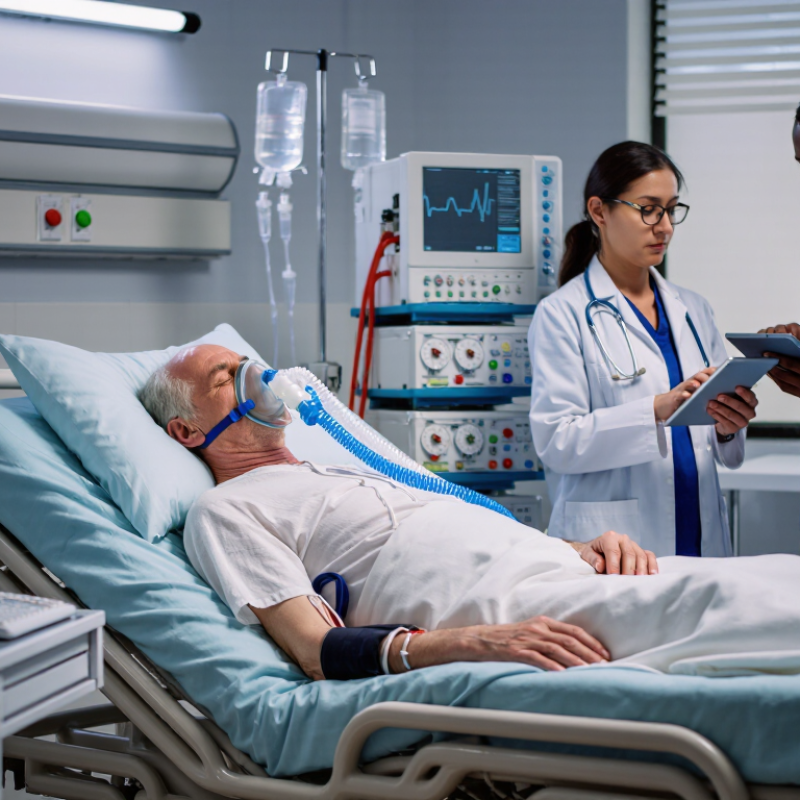
How Long Can a Patient Stay on a Ventilator?
A ventilator helps a patient breathe when the lungs cannot move enough air or oxygen. It pushes air through a breathing tube into the lungs. The machine can also remove carbon dioxide, a waste gas produced by the body. Nurses and respiratory therapists adjust oxygen levels, pressure, and breathing speed. They watch oxygen readings, blood tests, chest movement, and the patient’s comfort.
A patient may need ventilation during severe pneumonia, acute respiratory distress, major surgery, or a serious brain or muscle condition. Some patients use a tight face mask. Others need a tube placed through the mouth and into the windpipe. The tube can feel frightening and uncomfortable. Sedative medicine may help, but it can also cause confusion or weakness.
There is no universal time limit. Some people need support for several hours. Others require days or weeks. Longer ventilation can increase risks, including lung injury, infections, muscle weakness, and difficulty removing the breathing tube. Doctors usually reduce support when oxygen levels improve, breathing becomes stronger, and the patient can protect the airway. This process is called weaning.
A ventilator supports breathing. It does not cure the illness causing respiratory failure. That distinction is easy to miss. The care team reassesses the patient often, because recovery rarely follows a perfect schedule. A patient may improve, struggle, and improve again. Families can ask what the machine is doing, what progress looks like, and which problems may delay removal.
Mechanical ventilation may be needed for hours, days, weeks, or longer, depending on the cause of respiratory failure and the patient's recovery.
The chart shows clinically important time points rather than a maximum limit. Ventilation for more than 21 days is commonly considered prolonged mechanical ventilation, although definitions may vary. Some patients can be gradually weaned earlier, while others may require longer-term support. The care team regularly evaluates lung function, oxygen needs, breathing strength, and the underlying illness.
How long a patient stays on a ventilator depends on the illness, recovery speed, and response to treatment. Some patients need support for hours, while others require weeks. Timing varies widely. A fixed number of days cannot safely guide every decision.
Clinicians reassess the patient throughout the day. They review oxygen levels, blood gas results, breathing effort, lung mechanics, blood pressure, alertness, and the original cause of respiratory failure. They also check coughing strength and airway secretions. A patient may appear comfortable but still lack enough muscle strength to breathe independently. Sedating medicines can further complicate the picture.
When the patient seems stable, the team may reduce ventilator support and perform a spontaneous breathing trial. During this trial, they watch breathing rate, heart rhythm, oxygen levels, and signs of distress. Tolerance matters more than a single promising number. Assessment is not perfect. A patient can pass one trial and struggle later, especially after surgery, infection, or prolonged bed rest. If breathing remains unsafe, clinicians may pause the process, treat the underlying problem, and reassess. Family observations can also help, particularly when alertness or comfort changes. Decisions should reflect the patient’s medical condition, recovery goals, and informed preferences, rather than the calendar alone.
A ventilator can support breathing for hours, days, or months. The timeframe depends less on the machine than on the illness causing respiratory failure. After planned surgery, some patients breathe independently within several hours. Severe asthma, pneumonia, or sepsis may require several days. Recovery can take longer when lung inflammation, muscle weakness, or organ failure persists.
These are clinical ranges, not promises.
Acute respiratory distress syndrome often involves one to three weeks of ventilation, although mild cases may improve sooner. Severe pneumonia may require one or two weeks, while complicated infections can last much longer. After a stroke or brain injury, ventilation may continue for days or weeks. Patients with spinal cord disease or progressive neuromuscular weakness sometimes need months of support, occasionally at home. Chronic lung disease can create repeated weaning attempts.
In intensive care, clinicians check oxygen levels, breathing effort, alertness, cough strength, and blood gases during daily weaning assessments. A patient may pass one trial and fail the next. That is common. Sedatives, fluid buildup, delirium, and weak breathing muscles can delay removal.
If prolonged support seems likely, the team may discuss a tracheostomy, rehabilitation, and the patient’s wishes. Exact timing requires bedside assessment by the treating team.
How long can a patient stay on a ventilator? There is no fixed limit. Some patients need only several hours after surgery. Others require weeks because their lungs, heart, or nervous system remain unstable. In the ARDS Network trial, patients receiving lung-protective ventilation had 12.1 ventilator-free days by day 28, compared with 10.3 days under older settings. This finding supports careful pressure and volume control, not a guaranteed timeline.
Disease severity often prolongs ventilation. A French multicenter ICU report, published in JAMA, found a median ventilation duration of about 12 days among critically ill patients with severe viral pneumonia. Older age, chronic lung disease, bloodstream infection, kidney failure, and weak breathing muscles can delay liberation. Heavy sedation may also slow progress. So can thick secretions and poor cough strength.
The daily assessment matters. Clinicians usually check oxygen needs, blood pressure, mental alertness, cough, and spontaneous breathing ability. A patient may pass a breathing trial yet fail extubation because of airway swelling or muscle weakness. That is not always a mistake. It shows how incomplete bedside predictions can be. Research in Critical Care Medicine suggests that prolonged ventilation increases the risk of diaphragm weakness, pressure injuries, and hospital-acquired infection. Early mobility, lighter sedation, nutrition support, and coordinated weaning may shorten exposure when medically safe.
How Long Can a Patient Stay on a Ventilator?
Mechanical ventilation has no universal time limit. Some patients need several days, while others require weeks because of severe pneumonia, lung injury, weak muscles, or ongoing shock. The LUNG SAFE study reported that acute respiratory distress syndrome affected about 10% of intensive care patients receiving ventilation, with substantial mortality and prolonged respiratory support. Duration reflects illness, not a simple countdown.
Safe weaning begins with daily review. Clinicians assess alertness, oxygenation, blood pressure, cough strength, and secretion control. The 2017 ATS/ACCP guideline recommends structured liberation protocols and spontaneous breathing trials for suitable adults. The 2024 AARC clinical practice guideline also supports regular trials, usually lasting 30 to 120 minutes, while monitoring breathing effort and gas exchange. The ventilator is reduced carefully. Not abruptly.
A failed trial may show rapid breathing, sweating, falling oxygen levels, or rising carbon dioxide. The team returns support, searches for the cause, and reassesses later. Sedation, fluid overload, infection, and muscle weakness can delay progress. Extubation requires more than passing a breathing trial; the patient must also protect the airway and clear secretions. High-risk patients may need preventive noninvasive support after extubation. The process is not perfectly tidy. I would not treat any single score as truth. The ARDSNet trial showed that lung-protective ventilation reduced mortality from 39.8% to 31.0%, reinforcing the value of careful settings throughout support.
| Clinical Stage | Typical Time Frame | What Clinicians Assess | Common Weaning Approach | Safety Considerations |
|---|---|---|---|---|
| Initial invasive ventilation | Hours to several days | The underlying cause of respiratory failure, oxygenation, carbon-dioxide levels, lung mechanics, blood pressure, and organ function. | Use lung-protective ventilation when appropriate, treat the underlying illness, provide appropriate sedation and analgesia, and reassess daily. | Ventilator duration has no universal maximum. The safest duration is the shortest period that adequately supports breathing while the cause of failure is treated. |
| Daily readiness assessment | Usually performed every day once the patient begins to improve | Improving or resolved illness, adequate oxygenation on modest support, acceptable blood pressure without escalating support, sufficient respiratory drive, and manageable secretions. | Reduce unnecessary sedation, use spontaneous awakening trials when suitable, and screen for a spontaneous breathing trial. | Readiness criteria are individualized. Oxygen requirements, ventilator settings, neurological status, airway protection, and comorbidities must be considered together. |
| Spontaneous breathing trial (SBT) | Commonly 30–120 minutes | Respiratory rate and effort, oxygen saturation, heart rate, blood pressure, mental status, comfort, and signs of distress. | Allow breathing with minimal assistance under close observation. The trial may use low-level pressure support or a T-piece, depending on local practice and patient factors. | Stop the trial for sustained distress, worsening gas exchange, marked changes in vital signs, arrhythmia, severe agitation, or reduced consciousness. |
| Extubation assessment | After a successful SBT; timing varies by patient | Ability to protect the airway, effective cough, manageable secretions, adequate alertness, airway swelling risk, and a realistic plan for oxygen or noninvasive support after extubation. | Remove the endotracheal tube when both breathing ability and airway protection are adequate. Selected high-risk patients may receive preventive noninvasive respiratory support after extubation. | Passing an SBT does not guarantee successful extubation. Airway protection and secretion clearance are separate requirements. |
| Difficult or prolonged weaning | Days to weeks; sometimes longer | Respiratory muscle weakness, persistent lung disease, cardiac dysfunction, infection, malnutrition, anxiety, delirium, sleep disruption, and excessive sedation. | Use repeated or gradually lengthened SBTs, optimize nutrition and rehabilitation, treat reversible problems, and adjust sedation and ventilator support. | Progress may be uneven. A failed trial should prompt reassessment rather than automatic abandonment of weaning. |
| Prolonged mechanical ventilation | Often described in clinical literature as ventilation for 21 or more days, commonly with substantial daily use; definitions vary | Long-term prognosis, neurological recovery, respiratory muscle strength, rehabilitation potential, quality of life, and the patient’s previously expressed wishes. | Continue individualized weaning and multidisciplinary rehabilitation. A tracheostomy may be considered when prolonged airway access or ventilation is expected, but it does not guarantee faster weaning. | There is no fixed time limit that applies to every patient. Decisions should be reviewed regularly with the patient or legally authorized decision-maker. |
| If extubation is unsuccessful | Usually recognized within the first 48–72 hours, although monitoring continues beyond this period | Work of breathing, gas exchange, airway protection, secretion burden, mental status, and the cause of deterioration. | Provide urgent respiratory support, identify and correct reversible causes, and reassess whether reintubation or another strategy is safest. | Delayed reintubation can be dangerous in a deteriorating patient. The response should be based on clinical status, not on a fixed observation period alone. |
There is no universal time limit. Some patients need several hours after surgery. Others require weeks or months. The illness usually determines the duration.
Many patients breathe independently within several hours. Recovery may take longer after major surgery. Lung problems, sedation, or weakness can delay removal.
Severe pneumonia may require one or two weeks. Complicated infections can last much longer. Thick secretions may make breathing harder.
Acute respiratory distress often requires one to three weeks. Mild cases may improve sooner. Severe inflammation can keep the lungs stiff.
Yes. Ventilation may continue for days or weeks. Reduced alertness can affect airway protection. Weak coughing may also delay extubation.
Infection, fluid buildup, kidney failure, and weak breathing muscles can slow progress. Heavy sedation may delay alertness. Chronic lung disease can cause repeated failed trials.
They check oxygen levels, blood pressure, alertness, cough strength, and blood gases. A breathing trial may last 30 to 120 minutes. The process is careful.
The team usually restores more support and searches for the cause. Rapid breathing, sweating, low oxygen, or rising carbon dioxide may appear. A later trial may succeed.
No. The patient must also protect the airway and clear secretions. Airway swelling or muscle weakness can still cause failure. One test cannot tell everything.
It may be discussed when prolonged ventilation seems likely. The conversation can include rehabilitation and the patient’s wishes. Exact timing depends on bedside findings. I would not treat any single score as truth.
A ventilator is a life-support machine that helps a patient breathe when the lungs cannot provide enough oxygen or remove carbon dioxide effectively. A patient may need mechanical ventilation because of severe infection, respiratory failure, surgery, trauma, or a serious underlying illness. The question “how long can a patient stay on a ventilator” has no single answer. Doctors consider the patient’s lung function, overall health, cause of respiratory failure, response to treatment, and ability to breathe independently. Some patients need support for only a few hours or days, while others may require weeks or longer.
During treatment, the medical team regularly checks oxygen levels, breathing strength, alertness, and readiness for a breathing trial. If the patient improves, support is gradually reduced through a careful weaning process. This may involve adjusting machine settings, treating infections, managing sedation, and assessing airway protection. Recovery can be delayed by chronic lung disease, weakness, complications, or ongoing illness, so decisions are individualized and closely monitored for safety.

QMS Medical