Choosing the right ventilator begins with a clear understanding of its purpose, patient, and setting. Many readers ask, “what are the different types of ventilators?” The answer includes invasive ventilators, non-invasive ventilators, transport ventilators, neonatal models, and home-care devices. Each type supports breathing differently. Each also has limits.
Invasive ventilators deliver air through an endotracheal or tracheostomy tube. Non-invasive systems use a mask, often for patients who can breathe independently but need pressure support. Transport ventilators provide compact support during ambulance transfers, emergencies, or movement between hospital departments. Neonatal ventilators require precise control because newborn lungs are especially delicate. Home ventilators focus on long-term use, comfort, alarms, and caregiver training.
The choice matters. Clinical teams assess oxygen needs, airway protection, lung condition, mobility, and monitoring requirements. They also review manufacturer instructions and current clinical guidance before use. A device that works well in an intensive care unit may be unsuitable for a vehicle or bedroom. Practical details matter too. Battery duration, mask fit, humidification, alarm visibility, and cleaning procedures can affect real-world safety.
There is no single best ventilator for every patient. Even experienced teams can overlook a small operational detail. This guide compares major ventilator types, their typical applications, benefits, and limitations. It also considers how technology, patient comfort, and professional supervision influence safe selection. When uncertainty remains, qualified respiratory clinicians should guide the final decision.
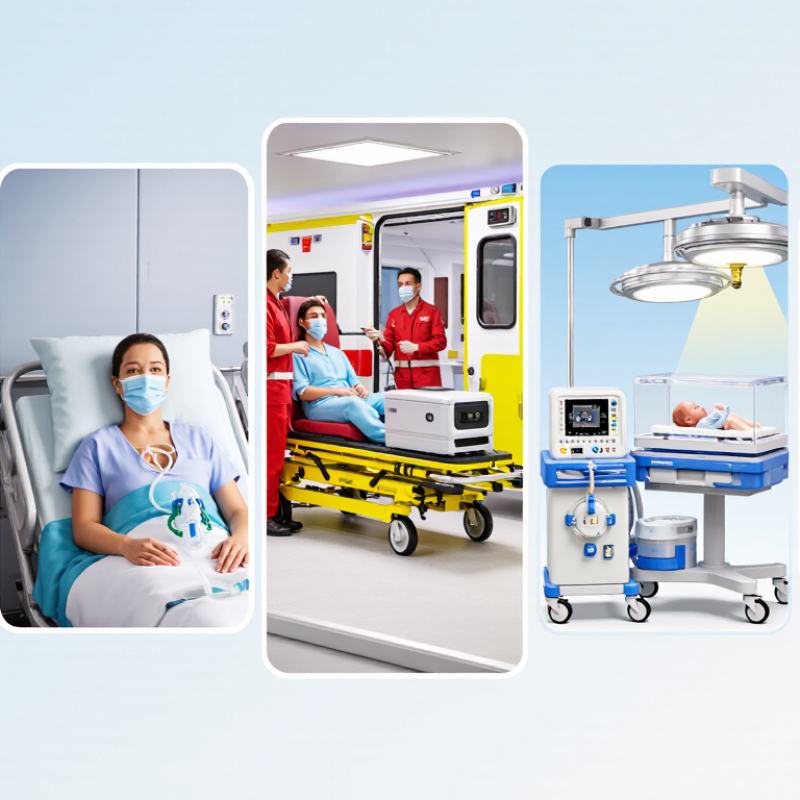
In 2026, ventilator classification should follow clinical function, not appearance. A practical taxonomy includes five types: critical-care invasive, non-invasive, transport, neonatal and pediatric, and home-care ventilators. The boundaries are not perfectly clean. Some devices serve several settings.
Critical-care invasive ventilators support intubated patients in intensive care. They provide precise pressure, volume, oxygen, and alarm control. Non-invasive ventilators deliver support through a mask, often for acute respiratory failure or sleep-related breathing disorders. The World Health Organization reported that chronic obstructive pulmonary disease caused 3.23 million deaths globally in 2019, showing the continuing need for respiratory support. However, ventilation is not automatically appropriate for every patient.
Transport ventilators are compact and battery-powered. They protect ventilation during ambulance transfers, aircraft movement, or hospital relocation. Neonatal and pediatric ventilators use smaller tidal volumes and more sensitive monitoring. A tiny leak can change performance. That detail is easy to underestimate. Home-care ventilators support longer-term treatment outside hospitals, where caregivers must manage power, cleaning, alarms, and emergency plans.
Industry reports from MarketsandMarkets and Fortune Business Insights forecast continued growth in the mechanical ventilator market through the decade, driven by intensive-care demand, aging populations, and respiratory disease. Forecasts vary because manufacturers define market segments differently. Buyers should therefore compare clinical workflows, not only projected market size. In practice, the safest selection depends on patient age, disease severity, mobility, staffing, and monitoring capacity. Data alone cannot replace bedside assessment.
Modern ventilators support breathing through two core patient interfaces: invasive and noninvasive. The choice depends on respiratory effort, airway protection, alertness, and expected treatment duration.
Invasive ventilation delivers air through an endotracheal tube or tracheostomy. It can provide precise pressure, volume, oxygen, and respiratory-rate control. This approach may help patients with severe respiratory failure or reduced consciousness. However, the tube can cause discomfort, airway irritation, infection risk, and communication difficulties. Continuous monitoring is essential.
Noninvasive ventilation uses a fitted mask or helmet without placing a tube inside the airway. It can support selected patients with acute breathing difficulty, chronic ventilatory failure, or sleep-related breathing problems. The patient must usually breathe spontaneously and protect the airway. Air leaks, skin pressure, dryness, anxiety, and poor tolerance can limit treatment. Small adjustments matter.
The boundary is not always clean. A mask may seem safer, yet delayed intubation can worsen fatigue in an unstable patient. Conversely, invasive ventilation may be unnecessary when careful noninvasive support works. Clinicians should reassess comfort, blood gases, breathing pattern, mental status, and treatment response. Patient preference also matters when circumstances allow. This decision needs judgment, not a checklist alone.
The two core patient interfaces are distinguished by whether ventilation uses an artificial airway or a mask-based interface.
How to read the chart: 1 indicates that the defining feature applies; 0 indicates that it does not. Invasive ventilation uses an endotracheal tube or tracheostomy to access the airway, while noninvasive ventilation delivers positive pressure through a mask or helmet without intubation or tracheostomy.
Ventilator control modes shape how each breath is delivered. Volume-controlled ventilation targets a set tidal volume, such as 500 mL, while pressure may vary with lung resistance. It offers predictable minute ventilation, but high airway pressures can develop when compliance worsens.
Pressure-controlled ventilation limits inspiratory pressure and creates a decelerating flow pattern. Tidal volume then changes with compliance, effort, and airway obstruction. Hybrid systems, including pressure-regulated volume modes, adjust pressure toward a volume target. They can respond to changing lungs, but automation is not perfect. A 2024 report from the World Health Organization emphasizes reliable oxygen systems, trained staff, and maintenance as core requirements for respiratory care. The report also warns that equipment availability alone does not guarantee safe treatment.
Clinical teams should interpret numbers beside the patient. A falling exhaled volume, rising respiratory rate, or visible chest struggle may signal poor synchrony. The 2024 Global Initiative for Chronic Obstructive Lung Disease report supports noninvasive ventilation for selected acute exacerbations, reinforcing the need for careful assessment rather than automatic mode selection. In practice, pressure control may suit stiff lungs, while volume control can help maintain ventilation during changing resistance. That comparison is useful, but never universal.
Tips: Check delivered volume, plateau pressure, alarm trends, and patient comfort together. Reassess after every adjustment. A mode that looks stable on-screen may still feel wrong to the patient.
Portable and transport ventilators are important examples in the 2026 ventilator landscape. In the United States, many of these devices are regulated as FDA Class II medical devices. This classification reflects moderate risk and the need for specific controls. It does not mean every model suits every patient or clinical setting.
Portable ventilators support mobility in hospitals, ambulances, clinics, and home-care environments. They usually combine compact design, battery operation, oxygen delivery, and adjustable ventilation modes. Transport ventilators are built for movement between care areas. Their alarms, rugged housing, and visible displays help clinicians respond during transfers. Some devices provide invasive ventilation, while others support noninvasive therapy through a mask.
Practical experience shows that portability creates trade-offs. Smaller batteries may limit operating time. Outdoor noise can make alarms harder to hear. A simple interface may reduce training time, yet hide important settings from inexperienced users. Battery estimates can also disappoint under heavy oxygen demand. Clinicians should verify device clearance, intended use, alarm performance, cleaning instructions, and compatibility with accessories. Training remains essential. A ventilator is not a plug-and-play solution. Patient condition, airway status, and monitoring requirements can change quickly. Care teams should follow current instructions for use and local clinical protocols. FDA classification provides regulatory context, but careful assessment determines whether a device is appropriate.
In 2026, ventilators are commonly grouped by clinical purpose and breathing support. Critical-care ventilators provide controlled support for patients with severe respiratory failure. They may deliver invasive ventilation through an endotracheal tube or selected non-invasive modes through a mask. The category matters more than the label. ISO 80601-2-12 addresses critical-care ventilators and their essential performance. It works alongside broader medical electrical equipment requirements. That distinction is easy to miss.
The standard focuses on basic safety and essential performance. Practical assessments can examine tidal volume, airway pressure, respiratory rate, oxygen delivery, and alarm behavior. Requirements may vary with the ventilator’s configuration and intended use. Test teams also consider foreseeable faults, power interruption, gas supply changes, and inaccurate sensor readings. Alarms should be noticeable, appropriate, and difficult to misunderstand. Silence matters too.
Not noise alone.
In clinical engineering reviews, a strong procurement file connects each claim with test evidence, maintenance instructions, and operator training. Staff should confirm how the device behaves during circuit disconnection, blocked tubing, or unstable oxygen supply. A passed laboratory test does not guarantee smooth operation in a crowded intensive-care room. Human factors remain imperfect. Interfaces can still confuse tired clinicians, especially during urgent care. Regular verification, documented servicing, and realistic bedside simulations help reveal weaknesses that specifications may hide.
Invasive ventilation uses a tube inside the airway. Noninvasive ventilation uses a fitted mask or helmet.
It may help during severe respiratory failure or reduced consciousness. It offers precise control of pressure, volume, oxygen, and breathing rate.
The tube may cause discomfort, irritation, infection risk, and communication difficulties. Continuous monitoring remains essential.
Selected patients with acute breathing difficulty may benefit. It can also support chronic ventilatory failure or sleep-related breathing problems.
The patient usually needs spontaneous breathing and airway protection. Mask leaks, dry air, skin pressure, and anxiety can reduce tolerance.
Not always. Delayed intubation may worsen fatigue when breathing becomes unstable.
They should check comfort, blood gases, breathing pattern, mental status, and treatment response. Patient preference matters when circumstances allow.
It addresses essential performance and basic safety. Testing may include tidal volume, airway pressure, oxygen delivery, breathing rate, and alarm behavior.
Laboratory results cannot show every crowded-room problem. Simulations can reveal confusion during circuit disconnection or unstable oxygen supply.
It should connect performance claims with test evidence, maintenance instructions, and operator training. A complete file can still miss human mistakes.
Understanding what are the different types of ventilators is essential for matching respiratory support to patient needs and clinical settings. Ventilators can be classified by clinical function into five broad groups, including critical-care, transport, emergency, home-care, and specialized systems. They also differ by patient interface: invasive ventilators deliver support through an artificial airway, while noninvasive ventilators use masks or similar interfaces without intubation.
Another important distinction involves control modes. Volume-controlled systems prioritize a set breath volume, pressure-controlled systems regulate airway pressure, and hybrid systems combine both approaches for greater flexibility. Portable and transport ventilators are designed for mobility and are generally regulated as FDA Class II medical devices in the United States. In intensive care, ventilator design and performance are guided by standards such as ISO 80601-2-12, which addresses essential safety and functional requirements. Together, these categories provide a practical framework for comparing ventilator capabilities, intended use, and patient support options.
QMS Medical